
ISSB Certification Pathway
ISSB in Kenya
Build practical expertise Kenya's adoption of the ISSB Standards, including its regulatory timeline, existing frameworks, and what it means for entities preparing to report.
Available with Professional Access
Applying Kenya's ISSB Jurisdictional Adoption in Practice
Kenya's adoption of IFRS S1 and S2 is reshaping sustainability reporting requirements, requiring practical skills to navigate ICPAK's roadmap and existing Kenyan reporting frameworks.
Why ISSB Jurisdictional Adoption in Kenya Matters
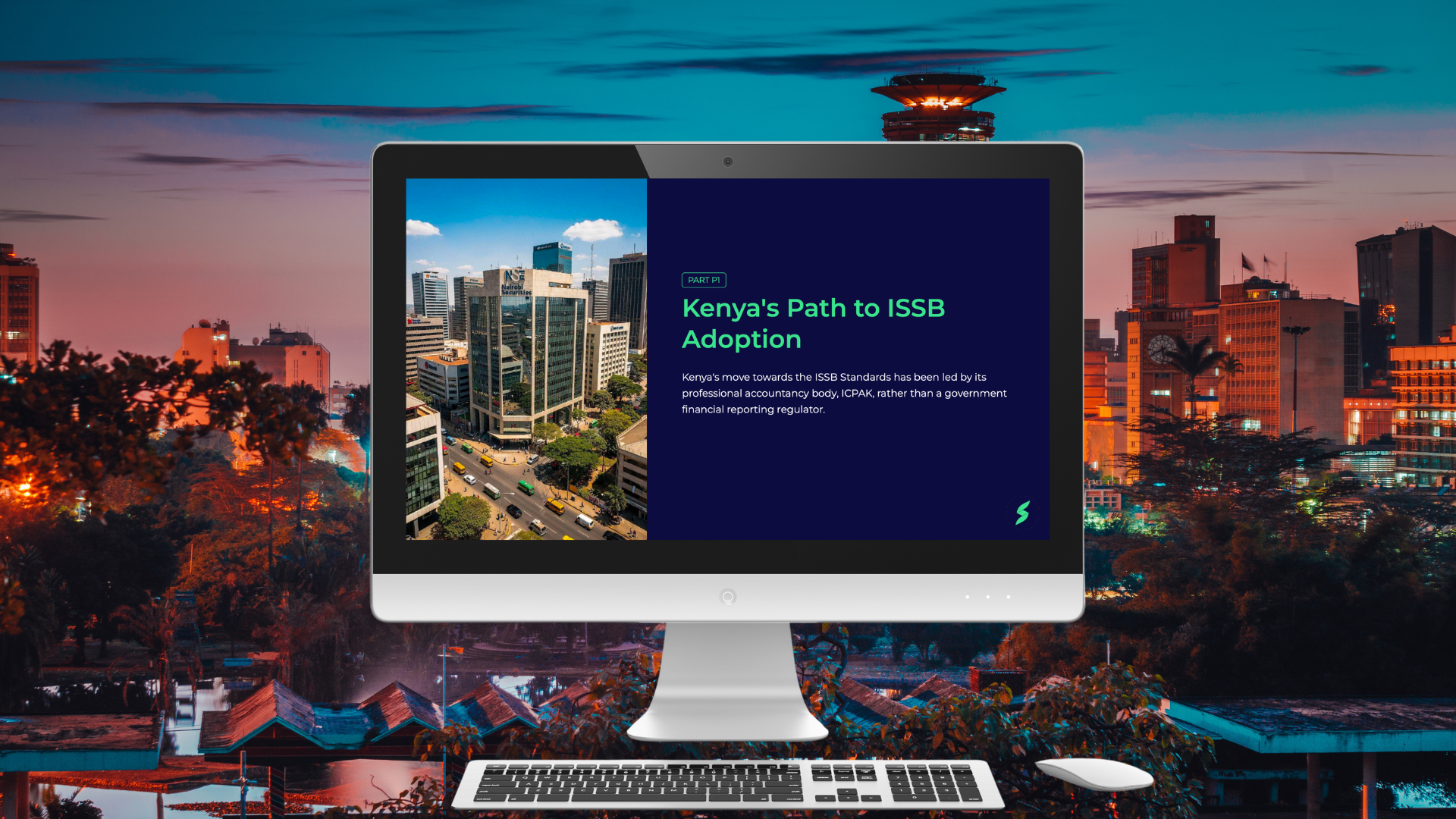
Kenya announced its intention to adopt the ISSB Standards in September 2023, led by the Institute of Certified Public Accountants of Kenya (ICPAK) rather than a government financial reporting regulator. Since then, ICPAK has issued a formal roadmap and accelerated the pace of implementation ahead of mandatory reporting.
Understanding Kenya's adoption approach, and how it interacts with existing frameworks such as the NSE's ESG Disclosures Guidance Manual, is essential for entities preparing for the 2027 mandatory deadline.
Key drivers include:
◆ Mandatory reporting for Public Interest Entities from 1 January 2027, one of the fastest timelines among African jurisdictions
◆ A mandatory readiness assessment, with listed companies required to submit theirs by 30 June 2026
◆ The need to integrate ISSB reporting with existing NSE, CBK, and CMA requirements
Kenya's Adoption of the ISSB Standards Certification Pathway
This pathway provides a practical, expert-led examination of Kenya's direct adoption model, covering ICPAK's roadmap, existing Kenyan frameworks, and the practical steps entities need to take to prepare.
It builds directly on the ISSB Professional course, applying that foundational knowledge to the Kenyan context using real-world examples, including recognised early adopters such as KCB Group.
You will learn how to:
◆ Understand Kenya's path to ISSB adoption and the key institutions involved
◆ Apply the direct adoption model and what it means to apply IFRS S1 and S2 as issued
◆ Understand how existing Kenyan frameworks interact with the ISSB Standards
◆ Apply ICPAK's regulatory timeline and readiness assessment requirements
Learning Outcomes
By completing this pathway, you will build a practical understanding of ISSB jurisdictional adoption in Kenya and how to prepare Kenyan entities for reporting.

Kenya's Path to Adoption
◆ Understand the timeline of Kenya's ISSB adoption, from ICPAK's 2023 announcement to the 2024 roadmap
◆ Identify the key institutions involved, including ICPAK, the CMA, the CBK, and the NSE
◆ Understand why Kenya chose a direct adoption approach

The Adoption Model and Existing Frameworks
◆ Understand what applying IFRS S1 and S2 "as issued" means in practice, including the prohibition on dual reporting
◆ Understand how existing frameworks, including the NSE's ESG Disclosures Guidance Manual, CBK climate risk guidance, and the CMA Code, interact with the ISSB Standards
◆ Identify how to map current disclosure obligations against ISSB requirements

Regulatory Timeline and Practical Preparation
◆ Understand ICPAK's phased roadmap and the readiness assessment requirements
◆ Understand the phased assurance trajectory from limited to reasonable assurance
◆ Apply practical steps for entities preparing to report, including sector-specific considerations
Certification Pathway Structure
Format
The ISSB Jurisdictional Adoption in Kenya pathway is a follow-on module to the ISSB Certification Pathway. Topics covered include:
Kenya's path to ISSB adoption and key institutions involved
Kenya's adoption model and existing frameworks
ICPAK's regulatory timeline and readiness assessment
Practical implications for entities preparing to report
Who This Is For
The ISSB Jurisdictional Adoption in Kenya pathway is designed for professionals preparing Kenyan entities for sustainability reporting:
◆ Public Interest Entities, including listed companies, banks, and insurers
◆ Banks and mortgage finance companies regulated by the CBK
◆ Capital market operators regulated by the CMA
◆ Sustainability, finance, and compliance professionals
◆ Internal and external auditors
◆ Large non-PIEs and SMEs preparing for phased mandatory adoption
Meet your Instructor
Orla Carolan is Head of Technical Training at the Sustainability Reporting Institute, responsible for developing and delivering training on reporting standards including CSRD (ESRS) and ISSB/IFRS Sustainability Reporting Standards (IFRS S1 & S2).
She also works freelance for the European Financial Reporting Advisory Group (EFRAG), contributing to the standard-setting process for ESRS and the recent simplification of standards following EU regulation changes.
A Chartered Certified Accountant (FCCA), Orla previously held senior roles in financial reporting and sustainability advisory at JPMorgan Hedge Fund Services and Grant Thornton Ireland.

Orla Carolan
Head of Technical Training, Sustainability Reporting Institute
Included with Professional Access

Get Professional Access today
€795 / per year
Professional Access includes:
- Access to this module
- Access to full ISSB certification path
- Access to all Sustainability Reporting Institute courses and certification paths
- Access to all expert-led sessions, interactive workshops and masterclasses
- Access to in-depth learning tools, resources and advanced templates
- Priority invitations and access to member-only networking events, discussions and peer groups
- Recognition and career-enhancing credentials
Frequently Asked Questions
Answers to common questions about ISSB jurisdictional adoption in Kenya.
Is ISSB adoption mandatory in Kenya?
Not yet for all entities. Mandatory reporting begins 1 January 2027 for Public Interest Entities, 1 January 2028 for large non-PIEs, and 1 January 2029 for SMEs.
What is Kenya's readiness assessment?
It's a self-assessment of an entity's governance, data, and materiality assessment capability across the four IFRS S1 and S2 disclosure pillars, required before mandatory adoption. Listed companies must submit theirs by 30 June 2026.
Has Kenya created its own version of the ISSB Standards?
No. Kenya has taken a direct adoption approach, applying IFRS S1 and IFRS S2 exactly as issued by the ISSB, with no local amendments and no dual reporting permitted.
Is the content live or recorded?
The pathway is pre-recorded and available on demand, so you can complete it at your own pace.
Do existing Kenyan frameworks still apply alongside the ISSB Standards?
Yes. Frameworks such as the NSE's ESG Disclosures Guidance Manual, CBK climate risk guidance, and the CMA's Code of Corporate Governance Practices continue to apply alongside IFRS S1 and S2.
How can I access this certification pathway?
This pathway is available through Professional Access.
Access the ISSB in Kenya Certification Pathway
Build a practical understanding of Kenya's direct adoption model and how to prepare for the 2027 mandatory deadline.
Available exclusively with Professional Access.
Enrol Today