
UK Sustainability Reporting Standards: What ISSB Adoption Means Now

The mandate of the ISSB is for the IFRS sustainability disclosure standards (IFRS S1 & S2) to become the global baseline for sustainability reporting. The UK government has decided to adopt a modified version of the standards and has now, UK SRS S1 and S2, and reporting teams need to move from watching this space to actively preparing for it.
This article sets out what UK SRS actually requires, the phased timeline companies are working to, and what a sensible starting point looks like.
From global baseline to local mandate
The UK has backed the ISSB's approach since COP26 in Glasgow in 2021, treating the global standards as the right baseline while reserving the right to make UK-specific modifications. That approach is now in place. UK SRS S1 and S2 are, in the vast majority of their content, identical to IFRS S1 and S2. What sets them apart is a small number of targeted amendments, each recommended by the UK's Technical Advisory Committee (TAC) or Policy and Implementation Committee (PIC) and confirmed through public consultation.
It is worth being precise about what those amendments do, because they cut both ways. Some make UK SRS more flexible than the global standard. Others make it stricter. Both matter for how you prepare.
Where things stand today
The Department for Business and Trade published the final UK SRS S1 and S2 on 25 February 2026, following a review that began in May 2024, exposure drafts consulted on from June 2025, and a consultation that closed in September 2025 with more than 200 responses. December 2025's ISSB amendments were incorporated directly into the final UK versions.
UK SRS is available for voluntary use now. On mandatory adoption, the Financial Conduct Authority (FCA) opened its consultation, CP26/5, in January 2026, proposing mandatory UK SRS for Main Market companies from 1 January 2027. A policy statement confirming the final position is expected in autumn 2026.
One important confirmation from the government: UK SRS S2 qualifies as a national reporting framework under the Companies Act, so companies reporting under it satisfy their existing climate-related financial disclosure obligations. For listed companies, adopting UK SRS S2 replaces the current TCFD-aligned requirements rather than adding another layer on top.
Who is in scope, and when
Two different groups matter here, and it is easy to conflate them.
Companies already in scope of the UK's existing climate disclosure regime under the Companies Act, broadly public interest entities with 500 or more employees, and large companies or LLPs with turnover above £500 million and 500 or more employees, already have a mandatory obligation to disclose against TCFD-aligned requirements today. Adopting UK SRS S2 satisfies that obligation now, ahead of any new mandate.
The new FCA mandate is narrower and phased. It proposes to apply to roughly 515 companies on the Main Market of the London Stock Exchange. AIM-listed companies are not within the FCA's proposed mandatory scope, though they may adopt voluntarily. The phasing itself is the detail most worth planning around:
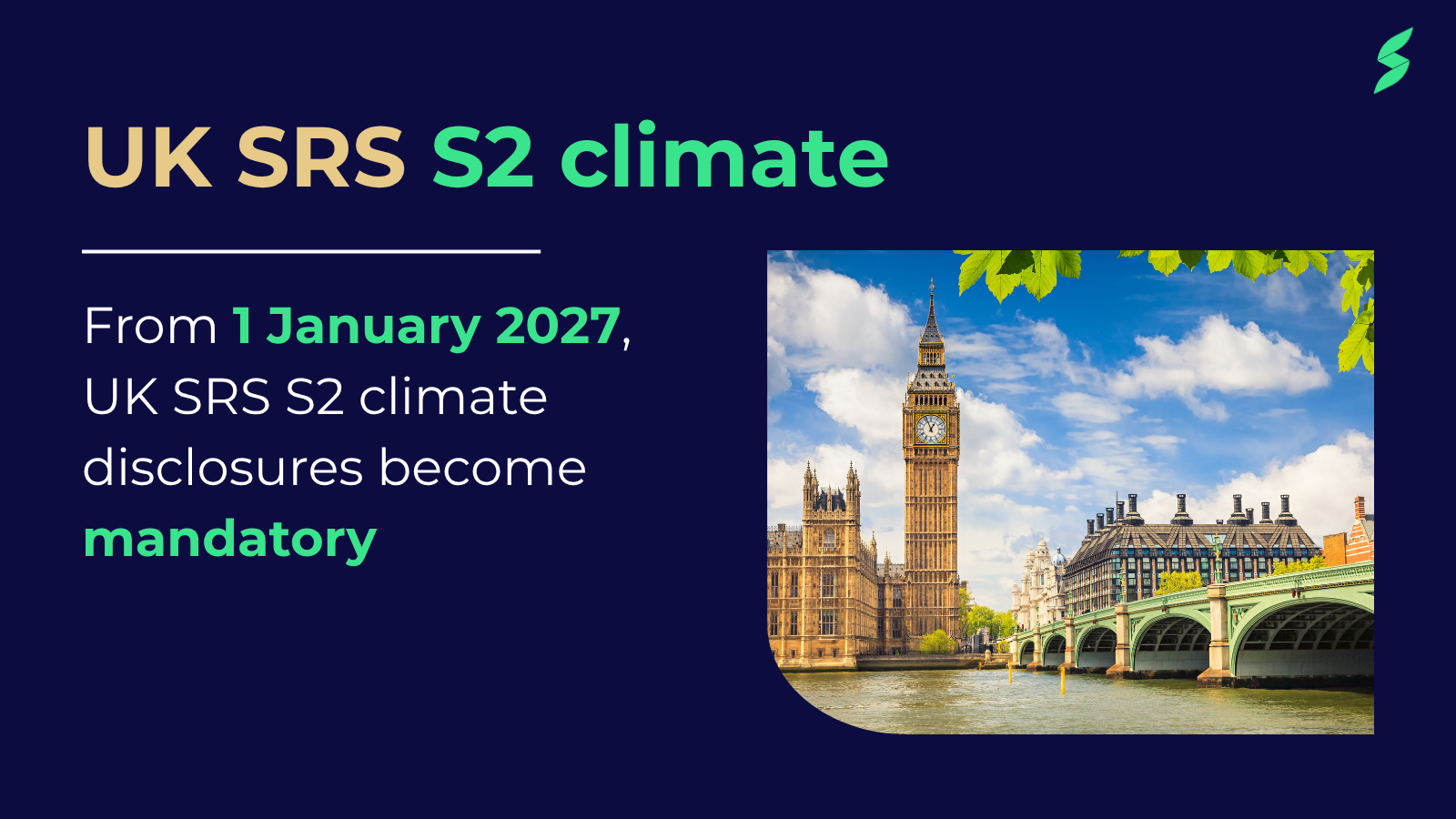
From 1 January 2027, UK SRS S2 climate disclosures become mandatory, with transition plan disclosure on a comply-or-explain basis. From 1 January 2028, Scope 3 greenhouse gas emissions follow, also comply-or-explain. From 1 January 2029, the broader UK SRS S1 sustainability disclosures become mandatory. All of this is subject to confirmation in the FCA's autumn 2026 policy statement, but the direction and sequence are clear.
Large private companies are not yet in scope. The government intends to consult on extending UK SRS through Companies Act amendments, under its Modernising Corporate Reporting programme, but no mandatory requirements have been confirmed for private companies at this stage.
What UK reporting teams should be doing now
Given the phasing above, climate disclosure is the immediate priority, since it leads the mandatory timetable by two full years over the broader S1 requirements. Scope 3 data infrastructure is worth building now rather than in 2027, given how much lead time good emissions data usually needs.
It also helps to understand precisely where UK SRS diverges from the global standard, since the differences are not all in one direction. Reference to SASB-based industry guidance is now discretionary rather than mandatory, which reduces the compliance burden for smaller entities or those in sectors with limited SASB coverage. Financial institutions get a new mechanism allowing them to explain, rather than simply fail, on financed emissions disclosure where full compliance is genuinely impracticable, provided they set out a plan and timeline.
Set against that, UK SRS removes the year-one timing relief that IFRS S1 permits, so sustainability disclosures must be published simultaneously with financial statements from the very first year of application. And a company using the climate-first relief cannot assert full UK SRS S1 compliance while doing so, even though it may still assert UK SRS S2 compliance. Taken together, these changes make UK SRS S1 stricter than the global standard from the moment of first application, not more lenient.
Assurance is also worth getting ahead of. The Financial Reporting Council's ISSA (UK) 5000 standard, the UK version of the international sustainability assurance standard, applies voluntarily to sustainability information reported for periods beginning on or after 15 December 2026. The FCA has not proposed mandatory assurance for the first reporting year, but investor pressure to seek it voluntarily may be significant, and the practical groundwork, documented internal controls, recorded data sources and judgements, and formal board sign-off, is worth building before it is asked for.
Build your UK SRS readiness
The Sustainability Reporting Institute's UK ISSB Jurisdictional Adoption module works through UK SRS S1 and S2 in detail, including the specific amendments and phased timetable covered here, and connects them back to the global ISSB standards for teams that need to report in more than one jurisdiction.
If you're building this expertise individually or preparing a team, our ISSB Standards certification path can build this capability, whether you're upskilling yourself or your reporting function.
Explore Professional Membership to access the full ISSB Certification path, including the UK ISSB Jurisdictional Adoption certification path here.

Frequently Asked Questions About UK SRS
What are UK Sustainability Reporting Standards (UK SRS)?
UK SRS are the UK's own version of the ISSB's global IFRS S1 and S2 standards. They are largely identical to the global standards, with a small number of UK-specific amendments confirmed through public consultation. The final UK SRS S1 and S2 were published on 25 February 2026.
When does UK SRS become mandatory?
The FCA has proposed a phased timetable: UK SRS S2 climate disclosures from 1 January 2027, Scope 3 GHG emissions from 1 January 2028, and broader UK SRS S1 disclosures from 1 January 2029, subject to confirmation in an autumn 2026 policy statement.
Which companies must comply with UK SRS?
The FCA's proposed mandate applies to around 515 Main Market-listed companies; AIM-listed companies are excluded. Separately, companies already covered by the UK's existing Companies Act climate disclosure regime, broadly public interest entities and large companies or LLPs with 500+ employees and turnover above £500 million, can satisfy that obligation now by adopting UK SRS S2.
How does UK SRS differ from the global IFRS S1 and S2 standards?
UK SRS is largely identical to the global standards but includes targeted amendments that cut both ways. It's more flexible in some areas, such as making SASB reference discretionary, but stricter in others, including the removal of the year-one timing relief and a requirement to publish simultaneously with financial statements from the first year of application.
Is assurance required for UK SRS disclosures?
Not yet. The FCA has not proposed mandatory assurance for the first reporting year, but the FRC's ISSA (UK) 5000 standard applies voluntarily to sustainability information reported for periods beginning on or after 15 December 2026.