Nigeria's ISSB Adoption: Why "Direct Adoption" Changes the Compliance Conversation

Nigeria announced its intention to adopt the ISSB's global sustainability disclosure standards at COP27 in November 2022, before the standards themselves had even been finalised. That early commitment has since become one of the more distinctive adoption stories on the continent, not because of when Nigeria moved, but because of how.
Unlike the UK, which we covered here (link to UK SRS blog), Nigeria has not modified IFRS S1 and S2, but has decided on direct adoption of the standards as they were issued by the ISSB. From COP27 to a working roadmap
Nigeria's Financial Reporting Council (FRC) leads on implementation, but it did not move alone. An Adoption Readiness Working Group (ARWG), bringing together regulators, businesses, accounting and sustainability professionals, audit firms, financial institutions, investors and academia, was established in June 2023 to guide the process. An exposure draft of the adoption roadmap followed in February 2024, with the first roadmap formally launched the following month.
The most recent milestone is the amended Roadmap and Sustainability Reporting Guideline 1 (SRG 1), unveiled in February 2026. Between them, they set out the current phased timetable, introduce a formal readiness assessment before entities can report, and clarify assurance requirements, all details we will come back to below.
What "direct adoption" actually means
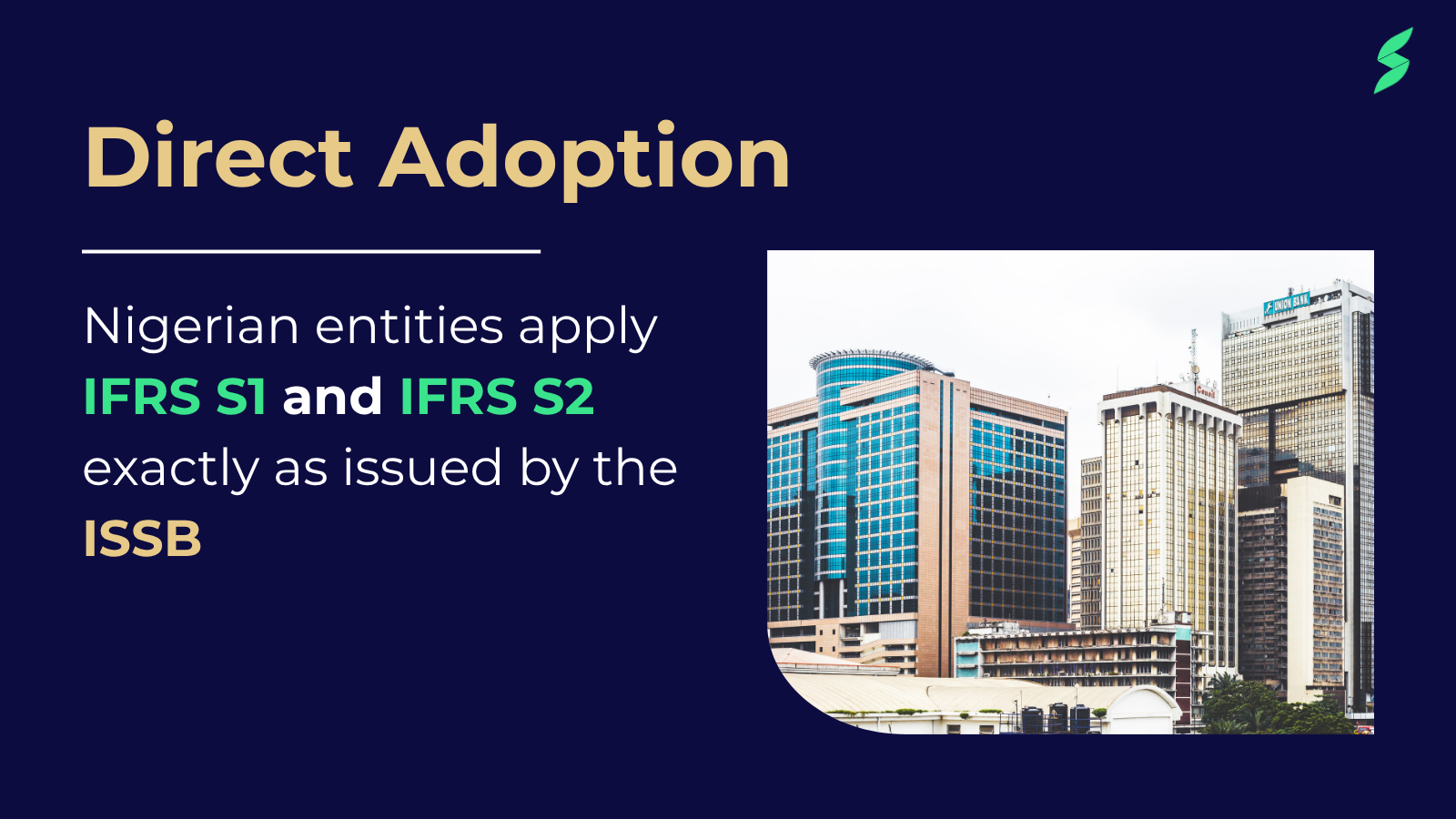
Some jurisdictions build a local version of the ISSB standards. The UK's approach, which we covered in detail last month, keeps IFRS S1 and S2 as the baseline but layers on UK-specific amendments confirmed through public consultation. Nigeria has taken a different route. There is no separate Nigerian version of the standards. Nigerian entities apply IFRS S1 and IFRS S2 exactly as issued by the ISSB, provisions, reliefs and all, with no local process for amending individual requirements.
That includes provisions that some jurisdictions choose to soften. Under IFRS S1, entities are required to refer to and consider the SASB Standards as a source of guidance, and Nigeria has not created a voluntary option for this requirement the way some other adopting markets have.
The FRC's reasoning for this direct adoption approach centres on four things: speed, since there is no additional process required to develop locally amended standards; simplicity, in applying the international standards as written; international credibility, from aligning Nigerian reporting directly with the global baseline; and comparability, since Nigerian disclosures sit alongside disclosures from any other jurisdiction using the same unmodified standards. Kenya, Zambia and Tanzania are reportedly planning similar direct-adoption approaches, which suggests this may become a genuine pattern across the continent rather than a one-off choice.
Who is in scope, and when
Nigeria's roadmap runs in three phases. Phase 1 covered early adopters reporting on or before 31 December 2023. Phase 2, voluntary adoption, runs from 1 January 2024 to 31 December 2027. Phase 3 begins mandatory adoption from 1 January 2028, starting with Significant Public Interest Entities. Government and government organisations follow the same 2028 start date through a separate IPSAS-aligned pathway. Mandatory requirements are then scheduled to extend to other companies, including SMEs, from 1 January 2030.
That leaves a genuinely long voluntary window, and a number of Nigerian companies have already used it. Access Holdings, Fidelity Bank, MTN Nigeria and Seplat Energy are recognised early adopters, and their experience, materiality assessments, board-level sustainability governance, and in some cases climate scenario analysis, offers a useful preview of the groundwork mandatory reporting will require.
A layered framework, not a replacement
Adopting IFRS S1 and S2 did not clear Nigeria's regulatory landscape of everything that came before it. Several existing frameworks continue to operate alongside the ISSB standards rather than being replaced by them: the NGX Sustainability Disclosure Guidelines for listed companies, dating to 2019 and historically encouraging GRI-aligned disclosure; the Central Bank of Nigeria's Sustainable Banking Principles, which apply to banks and other CBN-regulated institutions; the SEC's Sustainable Finance Principles, in place since 2021 for capital market operators; the Nigerian Code of Corporate Governance, which overlaps with but is broader than IFRS S1's governance pillar; and the Climate Change Act 2021, which is not a disclosure framework itself but generates information relevant to IFRS S2 climate reporting.
The practical implication is that Nigerian entities are rarely starting a sustainability reporting exercise from nothing. The more useful exercise is mapping what already exists under these frameworks against what IFRS S1 and S2 actually require, identifying what can be reused, what is genuinely missing, and where duplication can be designed out rather than repeated every reporting cycle.
What Nigerian reporting teams should be doing now
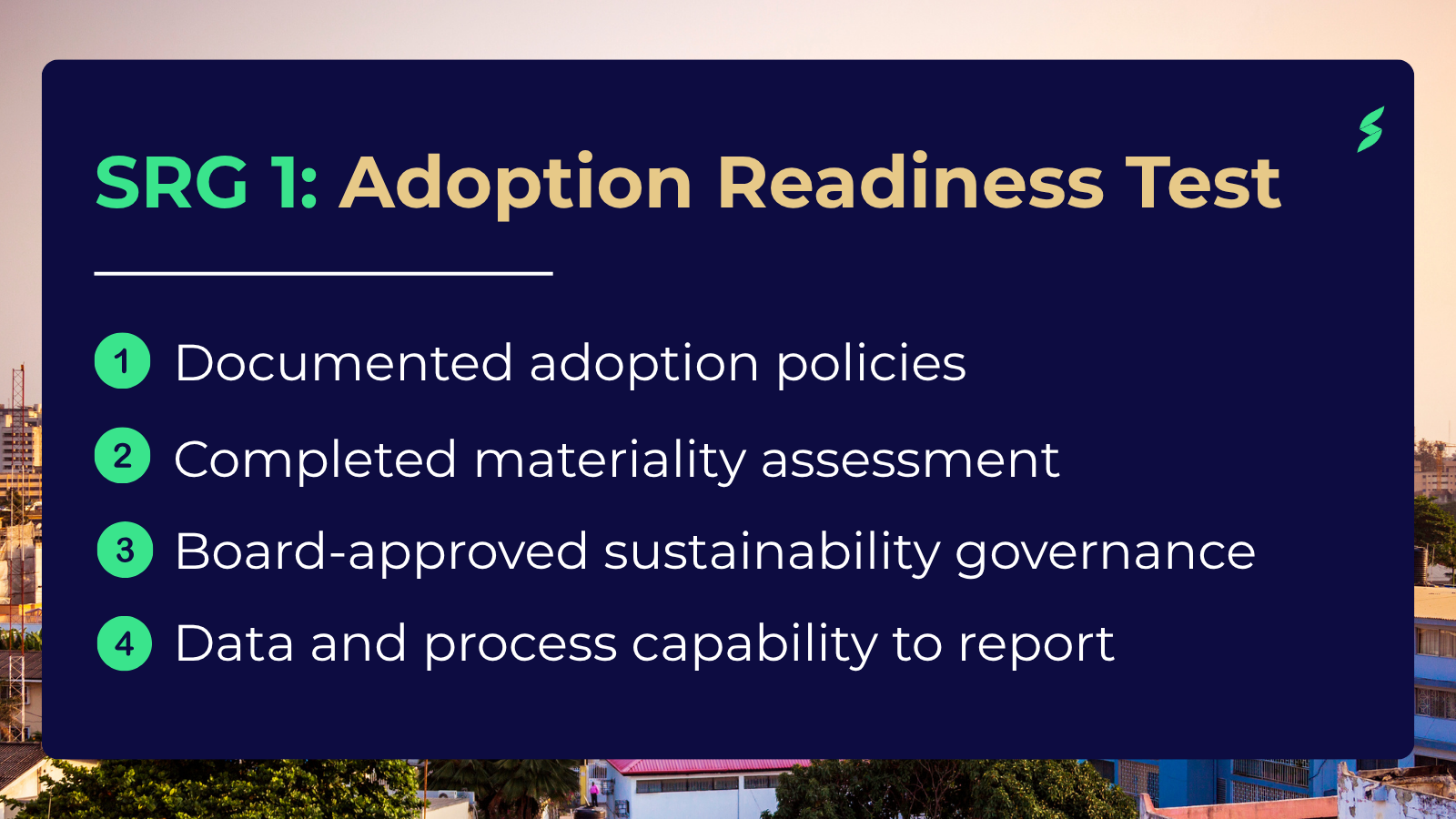
SRG 1's Adoption Readiness Test Assessment is the detail most worth planning around. Before an entity commits to a reporting date, it needs to demonstrate documented adoption policies, a completed materiality assessment of its sustainability and climate-related risks and opportunities, board-approved sustainability governance arrangements, and the internal data and process capabilities needed to actually produce the disclosures. The test exists specifically to reduce the risk of entities adopting the standards before their governance and data infrastructure can support credible reporting, so treating it as a formality rather than genuine due diligence is likely to backfire later.
Assurance is worth building toward from the outset rather than leaving until it becomes mandatory. Nigeria's roadmap moves from limited assurance in the earlier years of the mandatory regime toward reasonable assurance by around year six, built on ISSA 5000, which takes effect from 15 December 2026. Scope 3 emissions and climate scenario analysis are flagged as areas needing particular attention, which tracks with what most jurisdictions are finding: the emissions data furthest from an entity's own operations is consistently the hardest to get assurance-ready in time.
Build your Nigeria ISSB readiness
Whether you are preparing a Significant PIE for the 2028 mandatory start date, supporting a bank navigating both ISSB and the Nigerian Sustainable Banking Principles, or advising clients on when to move from voluntary to mandatory reporting, understanding Nigeria's direct adoption model in detail matters more than treating it as a smaller version of the UK or Australian approach.
Our ISSB Jurisdictional Adoption in Nigeria Certification Pathway works through the FRC's roadmap, the Adoption Readiness Test, and how Nigeria's existing frameworks sit alongside IFRS S1 and S2, in the depth this article can only summarise.
Explore the ISSB in Nigeria Certification Pathway here.
Frequently Asked Questions About ISSB Jurisdictional Adoption in Nigeria
When did Nigeria commit to adopting the ISSB standards? Nigeria announced its intention at COP27 in November 2022. The Adoption Readiness Working Group was established in June 2023, and the first roadmap was formally launched in March 2024.
What does "direct adoption" mean?
Nigeria applies IFRS S1 and IFRS S2 exactly as issued by the ISSB, with no local amendments.
When does ISSB reporting become mandatory in Nigeria? Significant Public Interest Entities must report from 1 January 2028, alongside government and government organisations through an IPSAS-aligned pathway. Mandatory requirements extend to other companies, including SMEs, from 1 January 2030. Voluntary adoption has been possible since 1 January 2024.
What is the Adoption Readiness Test? It is an assessment introduced through Sustainability Reporting Guideline 1 that entities must complete before adopting IFRS S1 and S2. It checks for documented adoption policies, a completed materiality assessment, board-approved sustainability governance, and the internal data and process capabilities needed to report credibly.
Do Nigerian entities still need to follow NGX, CBN or SEC sustainability requirements once they adopt ISSB? Yes. IFRS S1 and S2 sit alongside existing frameworks, including the NGX Sustainability Disclosure Guidelines, the Central Bank of Nigeria's Sustainable Banking Principles, and the SEC's Sustainable Finance Principles, rather than replacing them. Entities need to map requirements across all applicable frameworks.