
Why Climate Transition Plans Matter: A Practical Introduction for Sustainability Professionals

Climate transition planning is moving from a voluntary commitment to a business expectation. Investors, banks, and large customers increasingly want to see how a company will manage its climate impact over time, not just whether it acknowledges the issue. For sustainability reporting professionals, understanding what a credible transition plan involves is fast becoming part of the core job.
Yet the term itself can be off-putting. Climate transition planning sounds technical, and many teams are unsure where it sits alongside greenhouse gas accounting, climate risk assessment, and other climate-related disclosures. This article explains what a transition plan is, why it matters now, and how to take the first steps.
What is a climate transition plan?
A climate transition plan is a strategic document. It sets out how a company will manage its climate impact, and its exposure to a changing climate, over time. Like any strategy, it starts by measuring the current position, then defines targets and the actions needed to reach them.
Greenhouse gas accounting tells you where you are today. A transition plan is the next step. It turns that picture into clear targets, a roadmap of actions, and the governance to deliver them. It does not have to be a separate document. Many companies build these commitments into their wider business strategy.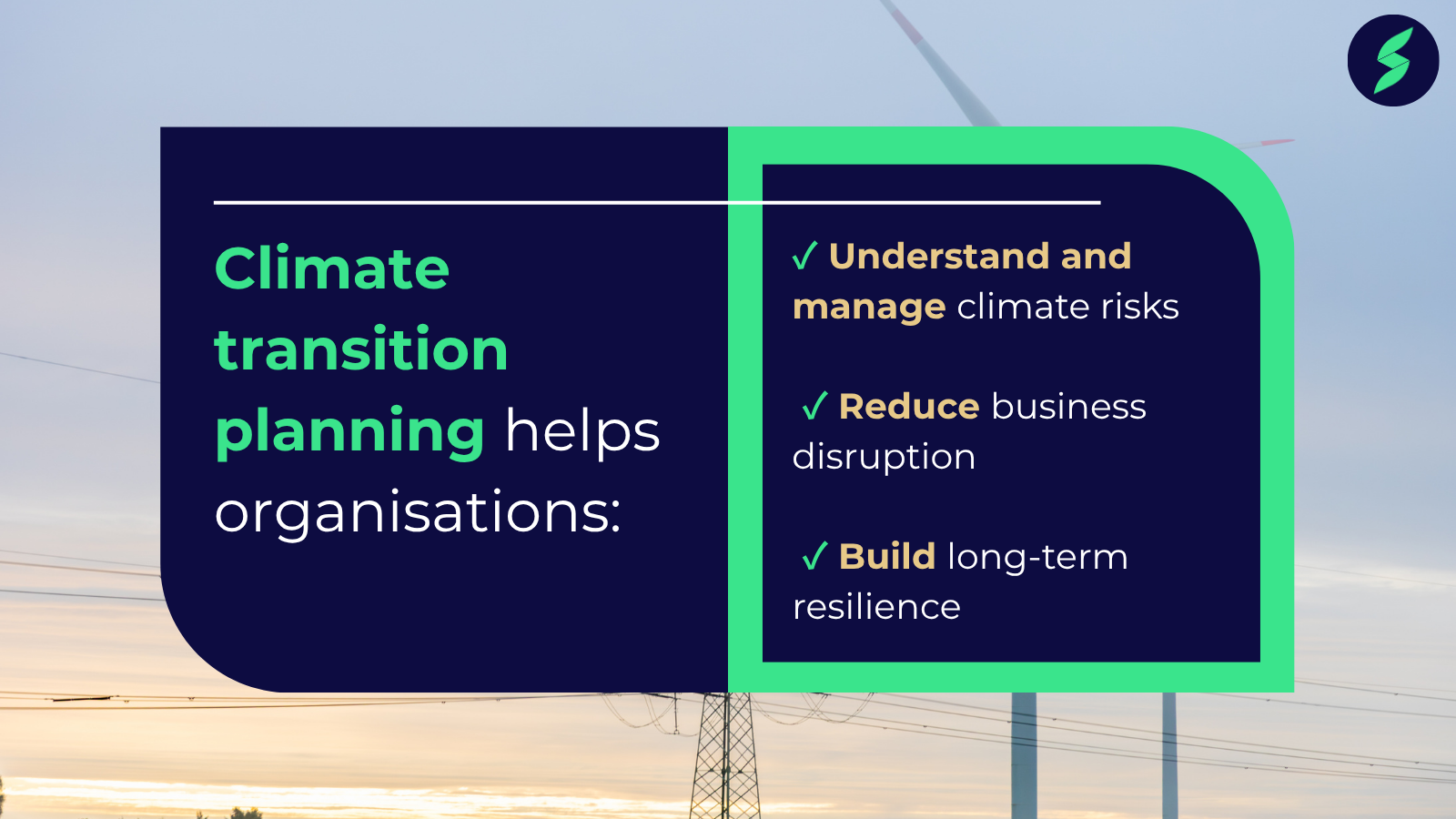
Climate change is a business risk
The most important shift in thinking is simple. Climate change is not only an environmental issue, it is a business risk. A drought that lowers a major river affects agriculture, river transport, energy generation, and every business that depends on them. Floods damage facilities, disrupt supply chains, and push up insurance costs. Wildfires close hotels and restaurants and cut off transport routes.
These risks sit alongside the financial, operational, and legal risks that companies already manage, and they often overlap with them. Managing climate change is part of running a resilient business, not a separate task bolted on the side.
The Paris Agreement and the pressure to act
In 2015, governments signed the Paris Agreement, which set three goals: to limit warming to well below 2°C and ideally 1.5°C above pre-industrial levels, to build resilience to the climate change already under way, and to direct financial flows towards low-carbon and climate-resilient activity.
Progress has been slow. In 2024, the global average temperature exceeded 1.5°C above pre-industrial levels for the first time across a full calendar year, according to the EU’s Copernicus Climate Change Service. A single year above the threshold does not mean the long-term goal is lost, since it is measured over decades, but it underlines how urgent the response has become.
Why investors, banks, and regulators are asking
Finance has become one of the main levers for change. Banks and investors increasingly assess how well a company understands and manages its climate risks before committing capital. In many markets, financial regulators now expect banks to set their own transition plans and to reduce the emissions linked to their lending.
That has a direct knock-on effect. A bank can only meet its portfolio targets by working with its clients across sectors such as transport, real estate, food, and manufacturing. So even if your company is not a financial institution, the day is coming when a lender, investor, or large customer asks whether you have a credible transition plan and how it is progressing. A plan is fast becoming a condition of access to finance, and in some cases a licence to do business.
Where to start
The starting point is your emissions. The Greenhouse Gas Protocol splits these into three scopes: scope 1 covers direct emissions from your own operations, scope 2 covers the energy you buy, and scope 3 covers the rest of your value chain, from suppliers through to the use of your products. Most companies begin with scopes 1 and 2, then build out scope 3 as they mature.
From there, a straightforward four step approach applies to almost any company: establish a baseline, set targets, plan the actions to meet them, then monitor, govern, and communicate progress. The widely used benchmark is the science based targets approach. For 1.5°C alignment, this means cutting scope 1 and 2 emissions by around 4.2% a year and reaching roughly 90% reductions by 2050. Smaller companies do not have to begin there, but it helps to know what good looks like and to be able to explain any difference.
Crucially, you are rarely starting from scratch. Energy efficiency projects, solar panels, electric vehicles, and existing insurance or crisis plans all count towards a transition plan. The first step is often simply recognising what you already have in place.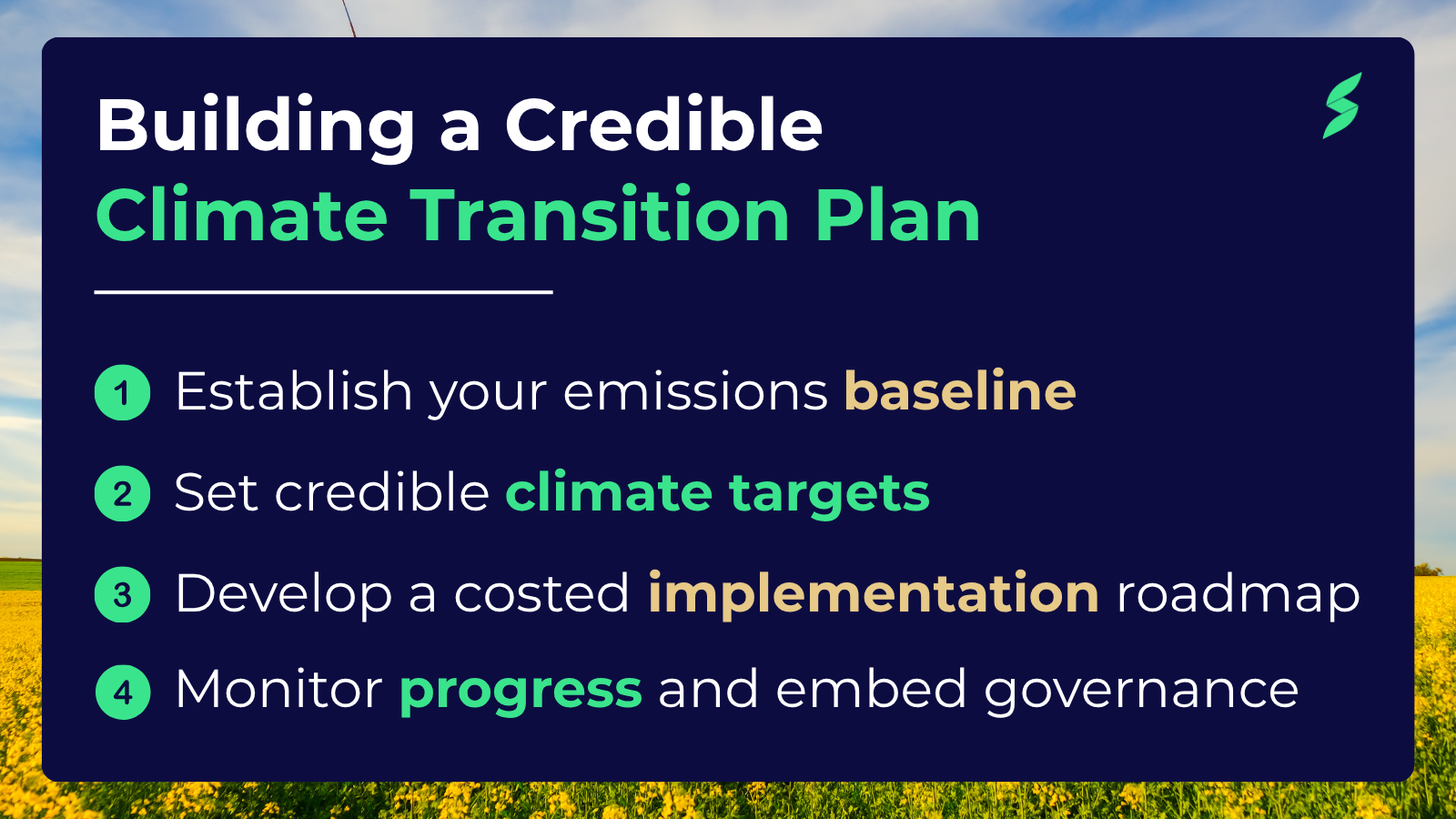
The benefits of acting early
A credible transition plan does far more than satisfy a disclosure requirement:
- It gives weight to climate commitments by turning them into measurable targets.
- It strengthens resilience by forcing a clear view of physical and transition risks.
- It improves access to finance and competitiveness.
- It supports regulatory compliance and protects reputation and stakeholder trust.
In short, it is a sound business strategy applied to climate. The companies that start now will be far better placed when the questions arrive.
Build your climate transition planning skills
To go deeper, the Sustainability Reporting Institute offers a four-part Climate Transition Plan Masterclass series, available to Professional Members. Delivered by Ieva Kustova of Futurcene, it works through the full methodology, from the business case and baseline setting to building a costed roadmap and applying it across sectors, using real published examples.
Become a Professional Member to access the series, along with our full library of masterclasses and expert resources. Find out more here.

FAQs on climate transition plans
- What is a climate transition plan?
A strategic plan that sets out how a company will reduce its emissions and manage climate risks over time, with clear targets, actions, and governance.
- How is it different from greenhouse gas accounting?
Greenhouse gas accounting measures your current emissions. A transition plan uses that baseline to set targets and a roadmap for reducing them.
- Do we need a separate transition plan document?
No. The commitments can sit within your wider business strategy, as long as the targets and actions are clear and credible.
- What are science based targets?
Emissions reduction targets aligned with climate science, typically around 4.2% a year for scope 1 and 2 emissions to stay on a 1.5°C pathway.
- Who needs a transition plan?
Increasingly, any company that reports on sustainability or seeks finance, as banks, investors, and large customers now expect one.